

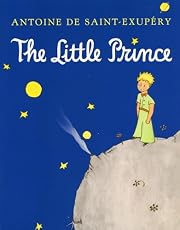
Cliquer sur une vignette pour aller sur Google Books.
|
Chargement... Le petit Prince (1943)par Antoine de Saint-Exupéry
  
» 97 plus Favourite Books (10) Best Fantasy Novels (89) BBC Big Read (8) 501 Must-Read Books (35) Five star books (18) 1940s (7) Short and Sweet (20) Books Read in 2016 (137) A Novel Cure (23) Magic Realism (73) Top Five Books of 2015 (503) Books Read in 2008 (12) Ambleside Books (272) Books Read in 2022 (1,217) Elevenses (250) BBC Big Read (86) Books About Boys (10) Children's Fantasy (49) Books Read in 2019 (3,125) Mix Tape 📚 (10) Books Read in 2020 (3,798) Childhood Favorites (273) Books Read in 2015 (2,947) All Things France (30) Books Read in 2018 (3,715) Books I've read (27) Beautiful Feet Books (147) Read in school (9) Plan to Read Books (15) Robin (3) Mo's Reading List (208) Africa (66) Unread books (802)
 AFNO | Jan 14, 2020 | AFNO | Jan 14, 2020 |   > Citations et Extraits (Babelio) : https://www.babelio.com/livres/Saint-Exupery-Le-Petit-Prince/36712#critiques_pre... > LE PETIT PRINCE, par Antoine de Saint-Exupéry. — Une histoire d'amitié entre un aviateur et un petit prince venu d'une autre planète, qui prend lieu en plein milieu du désert. — Ce livre m'a servi de bible. Il explique la beauté des relations interpersonnelles, qu'elles se résument dans les détails auxquels nous, adulte, portons que trop rarement attention. --Marie-Josée Lafleur (ICI.Radio-Canada.ca) > LE PETIT PRINCE, par Antoine de Saint-Exupéry. — Oeuvre essentielle de la littérature, ce livre de Saint-Exupéry est un ouvrage que l'on aura à coeur de raconter à son enfant, page après page, histoire aussi de redécouvrir l'enfant que l'on était autrefois, avant de devenir une grande personne ! --Xavier Marciniak > LES 150 CLASSIQUES DE LA LITTÉRATURE FRANÇAISE QU’IL FAUT AVOIR LUS !. — Le livre français le plus traduit au monde ! Ce conte au symbolisme marqué aborde sous les dehors d’une histoire pour enfants les grandes questions morales chères à l’auteur. (Adrian) --Publié le 07/05/2017, (Laculturegenerale.com) > Livre de coloriage sur le thème du Petit Prince d'Antoine de Saint-Exupéry à imprimer… ; (en PDF), URL : https://drive.google.com/open?id=1C9ielXlrSw-M_ZgcXg1yMdUorb_nUSui (  ) Joop-le-philosophe | Dec 1, 2018 | ) Joop-le-philosophe | Dec 1, 2018 |  ) )1  Dug87 | Feb 3, 2014 | Dug87 | Feb 3, 2014 | Voici mon secret. Il est très simple : on ne voit bien qu’avec le coeur. L’essentiel est invisible pour les yeux. Antoine de Saint-Exupéry démontre avec ce livre que l'on peut être quelqu'un de très sérieux — un pilote c'est du sérieux non — tout en gardant son âme d'enfant. Il nous ouvre son coeur et nous confie à mots couverts son amour pour Consuelo la belle salvadorienne. Au travers de l'image de cette fleur capricieuse, fragile, orgueilleuse mais tellement belle et surtout unique dans le coeur du petit prince, il illustre ses sentiments et les difficultés qu'il rencontre dans sa relation amoureuse. Le petit prince, qui assistait à l’installation d’un bouton énorme, sentait bien qu’il en sortirait une apparition miraculeuse, mais la fleur n’en finissait pas de se préparer à être belle, à l’abri de sa chambre verte. Elle choisissait avec soin ses couleurs. Elle s’habillait lentement, elle ajustait un à un ses pétales. Elle ne voulait pas sortir toute fripée comme les coquelicots. Elle ne voulait apparaître que dans le plein rayonnement de sa beauté. Eh ! oui. Elle était très coquette ! Sa toilette mystérieuse avait donc duré des jours et des jours. Et puis voici qu’un matin, justement à l’heure du lever du soleil, elle s’était montrée. C'est un livre qui nous amène vers l'essentiel; loin, très loin de nos préoccupations et de nos tracas quotidiens vers un endroit qui est pourtant tellement proche. http://www.aubonroman.com/2012/03/que-dire-de-plus-sur-ce-livre-archi.html ( )1 yokai | Mar 22, 2012 | )1 vdb | Dec 16, 2010 |
35 livres cultes à lire au moins une fois dans sa vie Quels sont les romans qu'il faut avoir lu absolument ? Un livre culte qui transcende, fait réfléchir, frissonner, rire ou pleurer… La littérature est indéniablement créatrice d’émotions. Si vous êtes adeptes des classiques, ces titres devraient vous plaire. De temps en temps, il n'y a vraiment rien de mieux que de se poser devant un bon bouquin, et d'oublier un instant le monde réel. Mais si vous êtes une grosse lectrice ou un gros lecteur, et que vous avez épuisé le stock de votre bibliothèque personnelle, laissez-vous tenter par ces quelques classiques de la littérature. Antoan de sent Egziperi (1900) linijski i ratni pilot, poginuo 1944. kao pilot-izviđač, oboren od nemačkih aviona. Pored niza romana o pilotima ("Južna poštanska služba", "Noćni let", "Zemlja ljudi", "Ratni pilot") napisao roman "Tvrđava", te neobično poetsku knjigu "Mali princ". Egziperi neguje kult razumevanja i duboke moralnosti, razvijajući vanvremensku veru u moć preobražavanja čoveka i dosezanja do pravog saznavanja njegove prirode. Mali princ je knjiga za male i velike, napisana poput bajke ona otkriva utopijski svet kroz priču o dečaku dospelom sa udaljene i sićušne planete i njegovom traganju za odanošću i ljubavlju. Ovo je knjiga i o stvarnom svetu, o čoveku, njegovim zabludama i grehovima, o nevinosti u otkrivanju najdubljih i najdragocenijih vrednosti postojanja, koja svojom sugestivnšću i poetskom toplinom osvaja decenijama generacije mladih i odraslih čitalaca.  "Il Piccolo Principe" è una di quelle letture che entrano nell'animo del lettore. Antoine de Saint- Exupéry con il suo stile semplice e poetico mette il lettore davanti ad una riflessione sul senso vero della vita e sull'importanza di coltivare i sentimenti. Una fiaba senza età e per ogni età, da leggere e rileggere. Vi segnaliamo la pagina del blog di Liberrima in cui parliamo del racconto dello scrittore francese: http://www.librerialiberrima.blogspot... Antoine de Saint-Exupéry, most metaphysical of aviators, has written a fairy tale for grownups. The symbolism is delicate and tenuous. It challenges man the adult, and deplores the loss of the child in man.  "The Little Prince" is a parable for grown people in the guise of a simple story for children-a fable with delightful delicate pictures of the little Prince on his adventurings. It is a lovely story in itself hich covers a poetic, yearning philosophy- not the sort of fable that can be tacked down neatly at its four corners but rather reflections on what are real matters of consequence. Appartient à la série éditorialeEst contenu dansGesamtausgabe: Gesammelte Schriften in drei Bänden: Band 1 Südkurier, Nachtflug, Wind, Sand und Sterne, Flug nach Arras, Der Kleine Prinz, Band 2Die Stadt in der Wüste, Band 3 Kleinere Schriften und Briefe par Antoine de Saint-Exupéry Fait l'objet d'une ré-écriture dansFait l'objet d'une suite (ne faisant pas partie de la série) dansFait l'objet d'une adaptation dansEst en version abrégée dansA inspiréContient un guide de lecture pour étudiantContient un guide pour l'enseignantPrix et récompensesListes notables
"Le Petit Prince" est le roman culte d'Antoine de Saint-Exupéry, un conte philosophique pour petits et grands qui a captivé des générations de lecteurs. Il raconte l'histoire d'un aviateur qui rencontre un petit prince venu d'une autre planète et apprend à travers ses rencontres avec lui les vérités sur l'amitié, l'amour et la vie. Le livre est illustré de charmantes illustrations et est rempli de réflexions profondes sur la vie et l'existence humaine. Il est un livre à lire absolument pour tous ceux qui cherchent à comprendre le monde qui les entoure et à trouver un sens à leur propre vie. À PROPOS DE L'AUTEUR Antoine de Saint-Exupéry était un écrivain, aviateur et aventurier français. Il est surtout connu pour son roman "Le Petit Prince", publié en 1943 et devenu un classique de la littérature mondiale. Il a également écrit des ouvrages sur ses expériences en tant qu'aviateur, tels que "Vol de nuit" et "Terre des hommes". Il a participé à de nombreux vols commerciaux et d'exploration avant la Seconde Guerre mondiale, mais il a finalement disparu lors d'une mission de reconnaissance en 1944. Son nom est associé à l'esprit d'aventure et de découverte. Aucune description trouvée dans une bibliothèque |
Discussion en coursFound: intergalactic traveler in love with a rose à Name that Book Couvertures populaires
 Google Books — Chargement... Google Books — Chargement...GenresClassification décimale de Melvil (CDD)843.912Literature French French fiction Modern Period 20th Century 1900-1945Classification de la Bibliothèque du CongrèsÉvaluationMoyenne: (4.23) (4.23)
Est-ce vous ?Devenez un(e) auteur LibraryThing. |
|||||||||||||||||||||||||||||||||||||||||||||||||||||||||||||||||||||||||||||||||||||||||||||||||||||||||||||||||||||||||||||||||||||||||||||||||||||


 Potencialidades do LT na animação


 14
14
Et comme je n'avais avec moi ni mécanicien, ni passagers, je me préparai à essayer de réussir, tout seul, une réparation difficile. C'était pour moi une question de vie ou de mort. J'avais à peine de l'eau à boire pour huit jours.